
HOW AFRICA’S INDUSTRIAL AMBITIONS ARE BEING FINANCED
From a US$20 billion refinery in Nigeria to a proposed US$16 billion investment in Kenya, Aliko Dangote’s expansion illustrates the growing importance of equity, debt and capital-market innovation in African industrial development.
BARAKAT AL-RIZQ CONSULT | FINANCIAL AND INVESTMENT RESEARCH
Africa’s industrial ambitions are becoming increasingly visible in the scale of investments being contemplated across the continent. Yet behind the announcement of every major refinery, manufacturing facility or infrastructure project lies a more fundamental question: where does the capital come from, and how is it structured?
Few African entrepreneurs illustrate this question more clearly than Alhaji Aliko Dangote, GCON, founder and President of Dangote Group. His business journey, from commodity trading to cement manufacturing, fertiliser production, food processing and petroleum refining, provides an unusually instructive case study in the relationship between private wealth and industrial capital.
Dangote’s latest ambitions extend beyond Nigeria. His proposed East African refinery in Lamu, Kenya, represents a potential investment of approximately US$16 billion and a planned processing capacity of 700,000 barrels of crude oil per day. It is one of the largest industrial projects ever proposed in the region.
The financing strategy behind these investments deserves as much attention as their physical scale.
From trading capital to industrial ownership
Dangote began his business career in 1978, trading commodities including rice, sugar and cement. Over time, he moved from trading into manufacturing, building businesses around products that underpin everyday consumption and industrial activity.
His official corporate biography identifies him as the founder and chief executive of Dangote Group and records his graduation from Al-Azhar University in Cairo.
The group has developed interests in cement, sugar, salt, fertiliser, food processing, petroleum refining and petrochemicals. Its expansion illustrates a familiar but difficult industrial transition: moving from the distribution of imported products to the domestic production of essential goods.
That transition requires more than entrepreneurial ambition. Manufacturing at scale involves large fixed assets, long construction periods, working capital, technical expertise, logistics, energy supply and access to markets.
It also requires a financing structure capable of accommodating significant upfront expenditure before the investment begins generating operating cash flow.
The refinery that changed the scale of the discussion
The Dangote Petroleum Refinery in Lagos is a defining example. With a nameplate capacity of approximately 650,000 barrels per day when it commenced operations in 2024, the refinery represented an investment exceeding US$20 billion.
The project demonstrated the ability of an African private sponsor to assemble capital, technical capacity and industrial infrastructure at a scale historically associated with major state-owned or international oil companies.
Its financing journey also illustrates the complexity of large industrial investments. The project involved substantial sponsor resources, external borrowing and subsequent capital restructuring.
In March 2026, Afreximbank announced that it had underwritten US$2.5 billion of a US$4 billion senior syndicated term loan for Dangote Petroleum Refinery and Petrochemicals FZE. Afreximbank and Access Bank were appointed co-mandated lead arrangers. The facility was intended to consolidate existing financing and optimise the refinery’s capital structure.
This is an important example of African financial institutions participating in the financing of strategic industrial assets. A syndicated facility allows several lenders to participate in a large financing commitment, with the arranging banks coordinating the transaction.
It is equally important to distinguish the financing structure accurately: the announced facility was a senior syndicated term loan, not a disclosed Shariah-compliant financing arrangement.
A significant development in the capital markets: the refinery IPO
The refinery’s financing story has entered another important phase through its proposed public share offering.
On 14 September 2026, Dangote Petroleum Refinery and Petrochemicals launched an initial public offering involving 4.1 billion ordinary shares at ₦525 per share. The original offer was expected to raise approximately ₦2.15 trillion, or around US$1.6 billion at the exchange rate used in the offering documentation.
The offer followed earlier private placements that raised approximately US$2.5 billion for a reported 7.2 billion shares.
The development became even more significant on 17 November. Reuters reported that demand for the IPO had reached nearly ₦6 trillion, approximately US$4.5 billion, around three times the initial shares offered. The refinery was considering increasing the offer by up to 30%, potentially raising approximately US$2.1 billion, subject to regulatory approval.
The proposed enlarged allocation could reach 5.33 billion shares, including an overallotment option. Following the offering, founder Aliko Dangote is expected to retain approximately 83.5% ownership, according to the Reuters report.
This is not simply a fundraising exercise. It represents a significant attempt to broaden ownership of a major African industrial asset while retaining control with its principal sponsor.
The transaction illustrates three important capital-market principles:
First, private placements: institutional investors can provide substantial capital before a public offering, helping finance expansion and establish an investment base.
Second, public equity: an IPO allows a wider group of investors to participate in the ownership of a company, while the issuer raises capital without creating an equivalent amount of new debt.
Third, capital-market liquidity: listing can provide a mechanism through which investors may buy and sell shares, subject to market conditions and applicable restrictions.
For African industrial development, the lesson is clear: capital markets can help transform large privately developed assets into investment opportunities accessible to a broader investor base.
Lamu: why Kenya has entered the equation
The next chapter of Dangote’s refining ambitions is taking shape in Kenya.
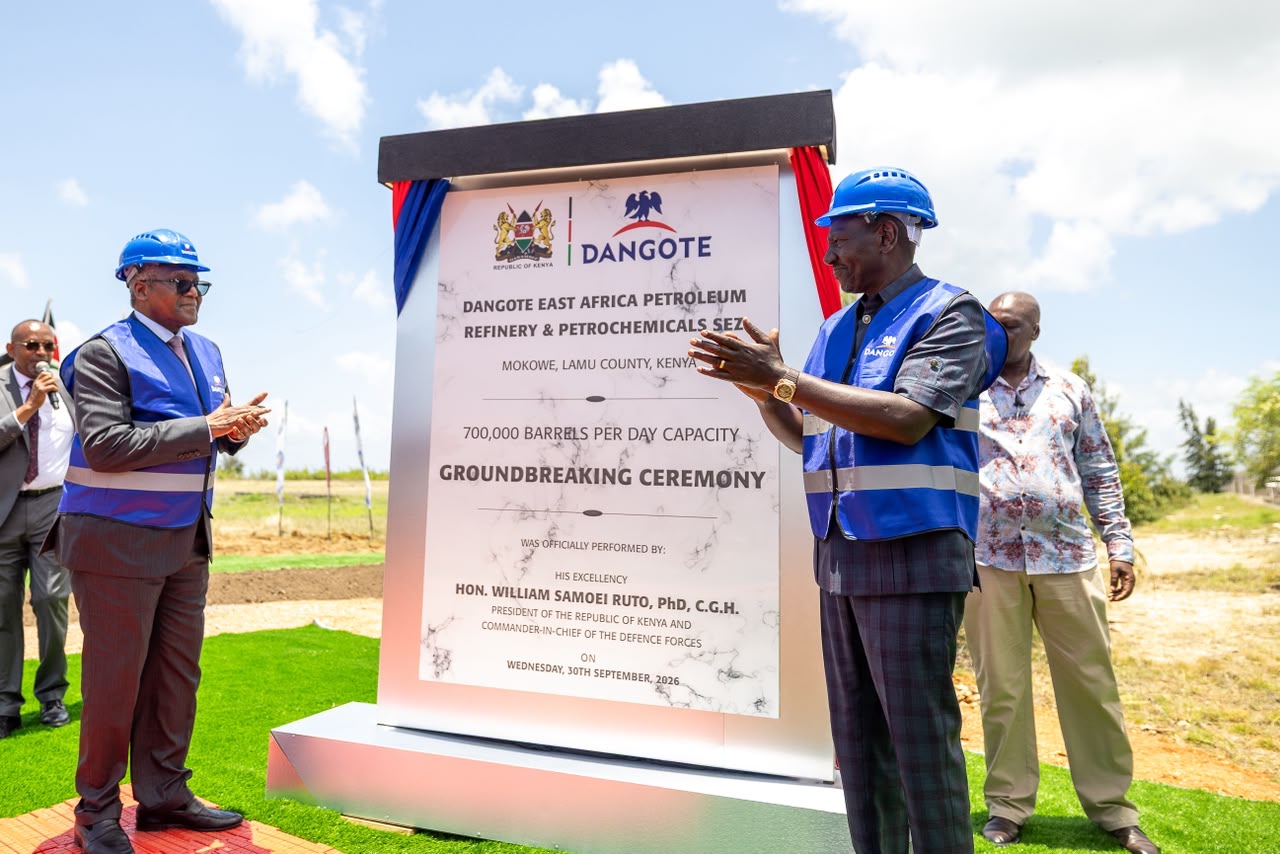
On 30 September 2026, Aliko Dangote and President William Ruto presided over the groundbreaking ceremony for the proposed East African refinery in Lamu County.
The project has been announced at approximately US$16 billion, with a planned capacity of 700,000 barrels per day and a target completion around 2030.
The proposed development is expected to serve Kenya and neighbouring markets, potentially reducing dependence on imported refined petroleum products. It is also intended to support a wider industrial ecosystem involving petrochemicals, energy and logistics.
The project has attracted international engineering participation. Engineers India Limited secured a contract worth more than US$450 million for project management and engineering, procurement and construction management services. This is a technical and project-management mandate, not the construction cost of the entire refinery.
The proposed refinery has also attracted public debate over land, approvals, project commitments and the arrangements governing public participation. These issues matter because an investment of this scale requires transparent governance, secure project rights, environmental and regulatory compliance, reliable crude supply and a credible financing plan.
A groundbreaking ceremony should not be confused with financial close or completion of all project approvals.
The proposed financing mix: cash, bonds and equity
In July 2026, a Dangote Industries executive told Reuters that the proposed Kenyan refinery was expected to be financed through a combination of internally generated cash, bonds and proceeds from a planned IPO.
The group had not publicly disclosed a complete final financing package or the exact cost at that stage.
The three proposed sources have different financial implications.
Internally generated cash allows a company to reinvest resources generated by its existing businesses. It reduces reliance on external lenders, although it also creates an opportunity cost because those funds could have been deployed elsewhere.
Bonds provide access to debt capital markets. Investors provide funds in exchange for contractual repayment and returns. Conventional corporate bonds generally involve interest-bearing obligations.
Equity provides capital in exchange for ownership. Unlike debt, equity does not ordinarily require scheduled repayment of principal, but it dilutes existing ownership and gives investors a share of the company’s economic rights.
The proposed participation of regional governments, with a combined equity offer of up to 30% reported around the project announcement, further illustrates the potential role of strategic shareholders.
These funding channels are not mutually exclusive. Large projects frequently combine sponsor equity, institutional debt, public equity and specialist financing arrangements.
Where Islamic finance enters the industrial equation
Dangote’s Muslim identity is documented in international profiles, including TIME and the Wall Street Journal. However, we have not identified a verifiable statement from him confirming that all the loans he obtains are structured under Shariah law because of his faith.
The public financing disclosures discussed above include conventional debt. It would therefore be inaccurate to present his entire financing portfolio as Shariah-compliant.
The more significant question is how Islamic finance could complement the financing of industrial projects of this scale.
A refinery, industrial park, renewable-energy plant or logistics facility may contain different assets and activities that can potentially be financed through distinct Shariah-compliant contracts.
These include:
- Istisna, for the construction or manufacture of specified assets.
- Ijarah, for the acquisition and leasing of eligible equipment.
- Murabaha, for the purchase and deferred sale of identified assets.
- Musharakah, for partnership-based equity investment.
- Sukuk, for investment certificates structured around eligible assets, usufructs or investment activities.
The choice depends on ownership, asset characteristics, contractual obligations, commercial risks and Shariah requirements. Islamic finance is not simply conventional debt with different terminology.
For African industrial projects, the potential is to broaden the investor base by allowing Islamic banks, Sukuk investors, private wealth institutions and other Shariah-sensitive capital providers to participate through appropriately structured instruments.
The wider African opportunity
Dangote’s investment strategy also reflects a wider shift in African industrial thinking: the continent is increasingly seeking to process more of its own resources, build regional supply chains and retain a greater share of the economic value created by domestic markets.
His announced US$2.5 billion fuel storage and pipeline project in Namibia, launched in November 2026, adds another dimension to this expansion. The project is intended to strengthen regional fuel distribution and logistics across Southern Africa.
Such investments create opportunities beyond the primary industrial asset. They can stimulate demand for power generation, water infrastructure, transport, storage, engineering, environmental services, housing, insurance and financial advisory.
This is where the role of specialist financial institutions becomes important. The challenge is not simply to identify capital providers. It is to prepare credible projects, structure transactions, allocate risk and ensure that investment is supported by sound governance.
For Kenya, the proposed Lamu refinery is a reminder that international investors assess more than the headline project cost. They examine project rights, infrastructure access, market demand, crude supply, financing commitments and the reliability of the operating environment.
Nairobi’s opportunity is to develop the professional and financial ecosystem that can support these transactions.
Barakat’s perspective: the capital structure matters as much as the capital amount
At Barakat Al-Rizq Consult, we view the evolution of African industrial investment through a broader financing lens.
The continent requires conventional debt, equity, development finance, private wealth and Shariah-compliant capital. These sources can complement one another where their respective structures are appropriate.
Islamic finance offers additional ways to mobilise capital into real economic activity, while private benevolent financing can support qualifying projects that may not fit conventional return-driven structures.
Our work focuses on energy and sustainable infrastructure, fiduciary project and investment advisory, and the facilitation of qualifying private Islamic financing through the BIC – Ihsan Qard Hasan framework.
The central question for Africa should not be whether one financing model replaces another. It should be how a wider range of credible financial structures can support productive investment while preserving accountability, transparency and economic value.
Dangote’s industrial journey demonstrates the scale of what African capital mobilisation can achieve. The next challenge is to ensure that the continent’s growing project pipeline can access the full range of responsible financing available to it.
BARAKAT AL-RIZQ CONSULT
Excellence With Integrity
- Dangote Group, official biography: https://www.dangote.com/aliko-dangote/
- Reuters, 7 July 2026, Dangote’s proposed Kenya refinery financing strategy: https://www.reuters.com/business/energy/dangote-fund-proposed-kenya-refinery-with-cash-bonds-an-ipo-2026-07-07/
- Afreximbank, 31 March 2026, US$4 billion syndicated term loan announcement: https://ebs.publicnow.com/view/34886A41D48BEE62FE15A7A55655F113C1BC2961
- Reuters, 17 November 2026, Dangote refinery IPO expansion: https://www.reuters.com/business/energy/dangote-refinery-expand-ipo-by-up-to-30-21-billion-sources-say-2026-11-17/
- Reuters, 30 September 2026, Kenya refinery groundbreaking: https://www.marketscreener.com/news/nigeria-s-dangote-breaks-ground-on-16-billion-east-african-oil-refinery-in-kenya-ce785ad2db80f126
- Reuters, 4 November 2026, Dangote’s Namibia fuel storage and pipeline project: https://www.reuters.com/world/africa/billionaire-industrialist-dangote-launches-25-billion-namibia-fuel-storage-2026-11-04/
- Wall Street Journal, 24 February 2025, Aliko Dangote profile: https://www.wsj.com/public/resources/documents/gF5stCg7QXNNJ2WzZZlu-WSJNewsPaper-2-24-2025.pdf
- TIME, interview with Aliko Dangote: https://time.com/91816/aliko-dangote/
Research qualification: The Lamu refinery’s announced investment value and capacity are project targets, not evidence of completed construction or financial close. The full financing package has not been publicly disclosed. The article does not suggest that Dangote’s disclosed borrowing is Shariah-compliant.
عُرض نص المقالة بلغته الأصلية، مع ترجمة عناصر التنقل إلى العربية.